

What the FDA has proposed
At the end of October 2026 the US Food and Drug Administration announced a proposed rule to update the nutrient requirements for infant formula, published in the Federal Register on 2 November (docket FDA-2026-N-10832). This first phase reviews eight of the 30 nutrients that every infant formula sold in the US must contain. For four of them it proposes new minimum or maximum levels; for chloride, potassium, selenium and sodium it considers the current levels still appropriate. Comments are open until 2 March 2027, and manufacturers would have three years to comply once the final rule takes effect.
The four nutrients, side by side with the EU
| Per 100 kcal | US today | US proposal | EU (Reg. 2016/127) |
|---|---|---|---|
| Iodine | 5–75 µg | 15–50 µg | 15–29 µg |
| Vitamin A | 75–225 µg | 70–120 µg | 70–114 µg |
| Vitamin D | 1–2.5 µg | 2–3 µg | 2–3 µg |
| Manganese | min. 5 µg, no maximum | 1–50 µg | 1–100 µg |
Minimum–maximum per 100 kcal. Vitamin A in µg of retinol equivalents.
The pattern is clear. For all four nutrients, the proposed US minimum is exactly the minimum the EU has applied to infant formula since 22 February 2020, and for vitamin D the whole range is identical. Where the US proposal and EU law still differ, it is in the maximums.
Why both limits matter
- Iodine is needed to make thyroid hormones, which are essential for growth and brain development. The proposal triples the US minimum and lowers the maximum by a third, because excess iodine can also disturb thyroid function.
- Vitamin A: the US maximum would fall by almost half, reflecting concern about excessive intake of preformed vitamin A. Only preformed vitamin A would count towards the requirement; beta-carotene could still be used but would no longer count.
- Vitamin D: the minimum doubles, and labels would declare it in micrograms instead of international units.
- Manganese gets a US maximum for the first time, because of possible adverse effects on neurodevelopment at high intakes.
Why precision is difficult
For the first months of life, infant formula is often a baby's only food. That is why the law sets a minimum and, for nearly every vitamin and mineral, a maximum as well. Staying inside a narrow window, can after can, depends on several things:
- The premix. Vitamins and minerals are added as a carefully weighed blend, and its composition and uniform distribution in the powder have to be verified.
- The milk itself. Milk naturally brings minerals, and their levels vary with the season and the cows' feed. The formulation has to take that into account.
- Shelf life. Some vitamins slowly degrade with oxygen, light and heat. A well-designed formula stays within the legal range from the first day to the last day of its shelf life.
- Analysis. Only testing of the finished product confirms that the label is true.
What it means for importers and distributors
- Standards are converging. When the United States moves its minimums to EU values, a formula built to European levels is already where regulation is heading.
- Ask for the full specification. Minimum and maximum per 100 kcal for every vitamin and mineral, backed by certificates of analysis, not just a list of nutrients on the label.
- Avoid costly reformulation. When a market tightens its limits, recipes, labels and registration files change too. A supplier already working within strict ranges saves you that work.
Vitamins and minerals in the Pronuben Baby range
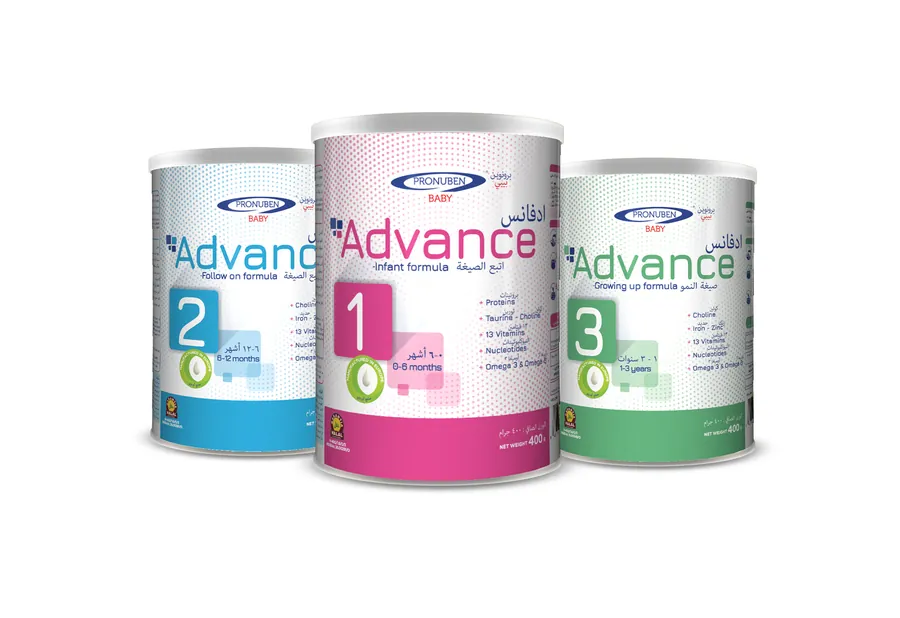
- Formulated to international standards. Our ADVANCE formulas follow the Codex Alimentarius standards for infant formula and follow-up formula, updated to their latest amendments.
- Complete profiles: ADVANCE 2 with 13 vitamins, ADVANCE 3 with 14 minerals, and PREMIUM 3 and our lactose-free LF with 13 vitamins and 14 minerals.
- European milk and production certified under ISO 9001, FSSC 22000, IFS Food, Halal, HACCP and GMP, plus ENAC accreditation.
- The same standard across the range: ADVANCE, PREMIUM with DHA, ARA, GOS and FOS, PREMIUM PLUS with HMOs and, from stage 2, probiotics, and our special formulas.
Looking for an infant formula built to European nutrient standards for your market? See how we work on the export and partners page.
Sources
- Federal Register. Infant Formula Nutrient Requirements, proposed rule (2 November 2026)
- US FDA. Infant Formula Notice of Proposed Rulemaking: Infant Formula Nutrient Requirements
- Morrison Foerster. FDA Proposes Significant Changes to Infant Formula Nutrient Requirements (6 November 2026)
- CNN. FDA plans to update infant formula nutrition requirements for first time in nearly 30 years (29 October 2026)
- Commission Delegated Regulation (EU) 2016/127, Annex I (EUR-Lex)