

What HMOs are
Human milk oligosaccharides (HMOs) are complex sugars naturally present in breast milk. After lactose and fat, they are its third largest solid component, and researchers have identified well over a hundred different structures. Babies do not digest them: HMOs travel to the gut, where they feed beneficial bacteria such as bifidobacteria and help shape the developing microbiota and immune system.
Cow’s milk contains only traces of these molecules. For decades, formula makers approximated their effect with prebiotic fibres such as GOS and FOS, which are still valuable and widely used.
From the laboratory to the tin
The turning point came when individual HMOs identical to those in breast milk could be produced at food-grade scale. In the European Union, 2’-fucosyllactose (2’-FL) and lacto-N-neotetraose were authorised as novel food ingredients in 2016, and other HMOs such as 3-fucosyllactose (3-FL) have followed through the same EFSA safety assessment.
A randomised multicentre trial published in 2017 in the Journal of Pediatric Gastroenterology and Nutrition compared a standard formula with the same formula enriched with two HMOs. The HMO formula was safe, well tolerated and supported normal growth, and the infants who received it had fewer reported cases of bronchitis and less antibiotic use during the first months. Research on HMOs is still growing, and much of it is industry-funded, so claims must stay within what the evidence and each country’s regulator allow.
Why it matters for the market
- A clear premium marker. HMOs have become the ingredient that separates a premium formula from a standard one in the eyes of paediatricians and parents.
- Science that health professionals recognise. HMOs are discussed in medical congresses and paediatric literature, which helps a new brand earn credibility with doctors and pharmacists.
- Regulatory readiness. Each market has its own rules for novel ingredients. An importer needs a manufacturer that can document the safety and authorisation of every ingredient for its registration file.
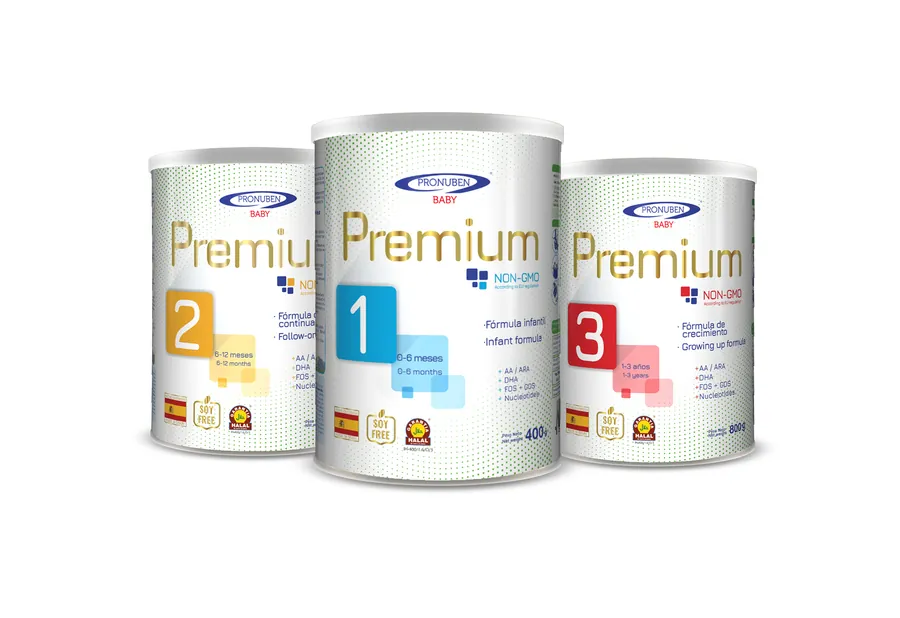
PREMIUM PLUS: HMOs inside a complete formula
Our PREMIUM PLUS range was developed for the top of the market, and it does not rely on a single star ingredient:
- Two HMOs, 2’-FL and 3-FL, identical to those found in breast milk.
- GOS and FOS prebiotic fibres, DHA and ARA and nucleotides in every stage.
- Specific probiotic strains from stage 2: Bifidobacterium animalis subsp. lactis and Lacticaseibacillus rhamnosus.
- European milk and certified production under ISO 9001, FSSC 22000, IFS Food, Halal, HACCP and GMP.
For a partner, that means a premium product with a clear scientific story for paediatricians, and three stages from birth to growing-up milk under one exclusive distribution agreement per country. Talk to us about distributing PREMIUM PLUS.
Sources
- Puccio G. et al. Effects of infant formula with human milk oligosaccharides on growth and morbidity: a randomized multicenter trial. J Pediatr Gastroenterol Nutr, 2017;64(4):624-631
- Bode L. Human milk oligosaccharides: every baby needs a sugar mama. Glycobiology, 2012;22(9):1147-1162
- European Commission: Novel food authorisations (Union list of novel foods)